
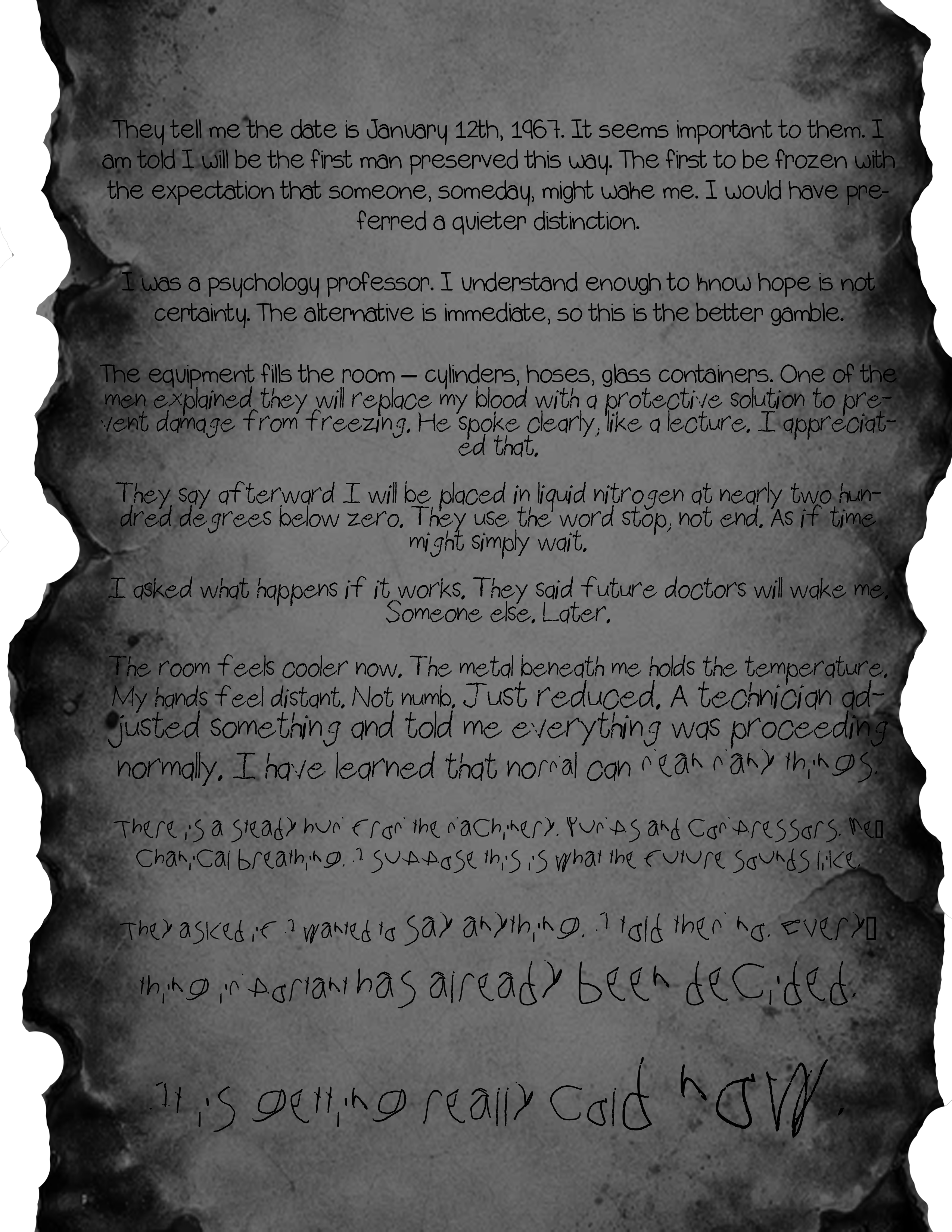
I have spent my career studying the way human beings assign meaning to events they cannot control. It is a professional habit that has not abandoned me this morning, even here, even in this room with its cylinders and hoses and the particular smell of machinery that has been running too long in a closed space. I observe. I note. I resist the impulse to interpret before the evidence is complete. Old habits.
My name is James Hiram Bedford. I am seventy-three years old. I hold a doctorate in psychology and spent the better part of four decades at the University of California, where I taught, wrote, and eventually directed the cancer research fund that bears my name. I have been a serious man. I hope that is apparent in what follows, because what follows is a serious account, and I would not have it mistaken for anything else.
I have kidney cancer. The diagnosis is not recent. The prognosis has been clear for some time. I mention it not for sympathy — I am past that — but because it is the precondition for everything that is happening in this room today, and a record without preconditions is not a record at all.
The Decision
I signed the agreement with the Cryonics Society of California some months ago. The organization is young. The science behind what they propose is younger still — a paper by Robert Ettinger published in 1962, a theory that biological death need not be irreversible if the body is preserved at temperatures cold enough to halt cellular decay before damage propagates beyond recovery. The claim is speculative. I know this. Ettinger himself is careful to say so. What he argues is not that cryonics will certainly work but that it represents a better gamble than the alternative, which is certain and immediate.
I am a psychologist. I understand probability. I understand also that human beings are poor intuitive statisticians, prone to weighting certain losses more heavily than uncertain ones of the same magnitude. I tried to reason through this with the same tools I would apply to any experimental question. The outcome of not agreeing to preservation: known. The outcome of agreeing: unknown but not impossible. When the expected value calculation is that straightforward, the decision is not difficult. I signed the papers.
What I could not calculate in advance was how it would feel to be in the room when it happened. That is what I am trying to set down now, while I still can.
The Room
Robert Nelson is here. He runs the Cryonics Society and has organized this himself. He is a television repairman by trade, which I mention not as a criticism but as context. The men in this room are not medical professionals in the conventional sense. They are enthusiasts — serious ones, careful ones, but enthusiasts. The equipment has been assembled from components not originally designed for this purpose. The procedures have been developed by reasoning from first principles rather than clinical trial. I knew all of this before I signed. I know it now. It does not change the calculation.
The room is cold. They have reduced the temperature in advance to slow the processes that begin at the moment of death. The metal beneath me holds the chill in a way that fabric does not. There is a steady mechanical sound from the compressors — rhythmic, indifferent, like the building has its own pulse now that mine is quieting.
A physician has been present to declare the moment of clinical death and to ensure that preservation begins as immediately as possible. The window matters. The brain tolerates interruption of blood flow for a matter of minutes before damage accumulates that no future medicine can address. Whatever chance this procedure offers depends almost entirely on the speed of what follows the declaration.
The Procedure
They will replace the blood with a preserving solution — dimethyl sulfoxide mixed with a carrier fluid — that penetrates the tissues and is meant to prevent the ice crystals that would otherwise rupture cell membranes during freezing. The technology for this is imperfect. I have read enough of the literature to understand that. The cryoprotectant available in 1967 is a first approximation of what will eventually be needed, not the final answer. Whether it is sufficient to preserve enough cellular structure to allow future revival is a question that cannot be answered today. It may not be answerable for a very long time.
After the perfusion, I will be cooled gradually and then stored in liquid nitrogen at approximately negative one hundred ninety-six degrees Celsius. At that temperature, all biological processes halt. Not slow — halt. There is no decay, no further damage, no passage of biological time. The bet, at that point, is simply on the future: that medicine will eventually develop the means to reverse what has happened, repair what has been damaged, and wake whoever is in the tank.
I asked Nelson this morning what he genuinely believed the odds were. He was quiet for a moment and then said he did not know, but that he thought they were better than zero. I told him that was good enough for me. It is not a confident answer. It is an honest one, and at this point in a man's life, honesty matters more than confidence.
What I Want Said
I have thought about what a person says when there may not be another opportunity to say anything. The instinct is toward the large and the lasting — toward statements of belief or love or principle that will outlive the speaker by some meaningful interval. I have resisted this. The record I want to leave is not rhetorical. It is observational.
What I observe is this: the room is ordinary. The men in it are doing their best with the tools they have. The machinery is imperfect. The science is incomplete. And I am choosing to trust the future anyway — not because I am certain the future will deserve that trust, but because the alternative requires no trust at all, and I have spent seventy-three years believing that the willingness to bet on an uncertain outcome is one of the things that separates a life from a waiting period.
If someone reads this in some future decade, having found it in whatever archive holds such things, I want them to know that I was not frightened. I was cold — that is the accurate word — and I was paying attention, which is the only posture I know how to hold when something important is happening.
They are ready now. The room has taken on a particular quality of stillness that I recognize from the end of long experimental sessions, when the work is done and the results are on the table and all that remains is to record them accurately.
It is getting cold. That is the last accurate observation I expect to make for some time.
I will note it, and then I will wait.